
Uneven air gap between stator and rotor (commonly known as “air gap eccentricity”) in large hydro-generators is a serious fault mode that can have a series of adverse effects on the stable operation and lifespan of the unit.
In simple terms, uneven air gap causes asymmetric magnetic field distribution, which in turn triggers a series of electromagnetic and mechanical problems. Below we analyze in detail the impact on stator current and voltage, as well as other associated adverse consequences.
I. Impact on Stator Current
This is the most direct and obvious effect.
1. Increased Current and Waveform Distortion
Principle: In areas with smaller air gaps, the magnetic resistance is smaller and the magnetic flux density is larger; in areas with larger air gaps, the magnetic resistance is larger and the magnetic flux density is smaller. This asymmetric magnetic field induces unbalanced electromotive force in the stator windings.
Performance: This causes imbalance in the three-phase stator currents. More importantly, a large number of high-order harmonics, especially odd harmonics (such as 3rd, 5th, 7th, etc.), are introduced into the current waveform, causing the current waveform to no longer be a smooth sine wave but to be distorted.
2. Generation of Current Components with Characteristic Frequencies
Principle: The rotating eccentric magnetic field is equivalent to a low-frequency modulation source that modulates the basic power frequency current.
Performance: Sidebands appear in the stator current spectrum. Specifically, characteristic frequency components appear on both sides of the fundamental frequency (50Hz).
3. Local Overheating of Windings
Principle: Harmonic components in the current increase the copper loss (I²R loss) of the stator windings. At the same time, harmonic currents generate additional eddy current and hysteresis losses in the iron core, leading to increased iron loss.
Performance: The local temperature of the stator windings and iron core rises abnormally, which may exceed the allowable limit of insulation materials, accelerate insulation aging, and even cause short-circuit burnout accidents.
II. Impact on Stator Voltage
Although the impact on voltage is not as direct as on current, it is equally important.
1. Voltage Waveform Distortion
Principle: The electromotive force generated by the generator is directly related to the air gap magnetic flux. Uneven air gap causes distortion of the magnetic flux waveform, which in turn causes the induced stator voltage waveform to also be distorted, containing harmonic voltages.
Performance: The output voltage quality decreases and is no longer a standard sine wave.
2. Voltage Imbalance
In severe asymmetric cases, it may cause a certain degree of imbalance in the three-phase output voltage.
III. Other More Serious Adverse Effects (Caused by Current and Voltage Problems)
The above current and voltage problems will further trigger a series of chain reactions, which are often more fatal.
1. Unbalanced Magnetic Pull (UMP)
This is the most core and dangerous consequence of air gap eccentricity.
Principle: On the side with a smaller air gap, the magnetic pull is much greater than on the side with a larger air gap. This net magnetic pull (UMP) will further pull the rotor toward the side with the smaller air gap.
Vicious Cycle: UMP will self-aggravate the problem of uneven air gap, forming a vicious cycle. The more severe the eccentricity, the greater the UMP; the greater the UMP, the more severe the eccentricity.
Consequences:
•Increased Vibration and Noise: The unit generates strong frequency-doubled vibration (mainly 2 times the power frequency, 100Hz), and the vibration and noise levels increase significantly.
•Mechanical Damage to Components: Long-term UMP will cause increased bearing wear, journal fatigue, shaft bending, and may even cause the stator and rotor to rub against each other (mutual friction and collision), which is a devastating failure.
2. Increased Unit Vibration
Sources: Mainly from two aspects:
1.Electromagnetic Vibration: Caused by unbalanced magnetic pull (UMP), the frequency is related to the rotating magnetic field and grid frequency.
2.Mechanical Vibration: Caused by bearing wear, shaft misalignment and other problems caused by UMP.
Consequences: Affects the stable operation of the entire generator set (including the turbine) and threatens the safety of the powerhouse structure.
3. Impact on Grid Connection and Power System
Voltage waveform distortion and current harmonics will pollute the plant power system and inject into the grid, which may affect the normal operation of other equipment on the same bus and does not meet power quality requirements.
4. Reduced Efficiency and Output Power
Additional harmonic losses and heating will reduce the efficiency of the generator, and under the same input water power, the useful active power output will decrease.
Conclusion
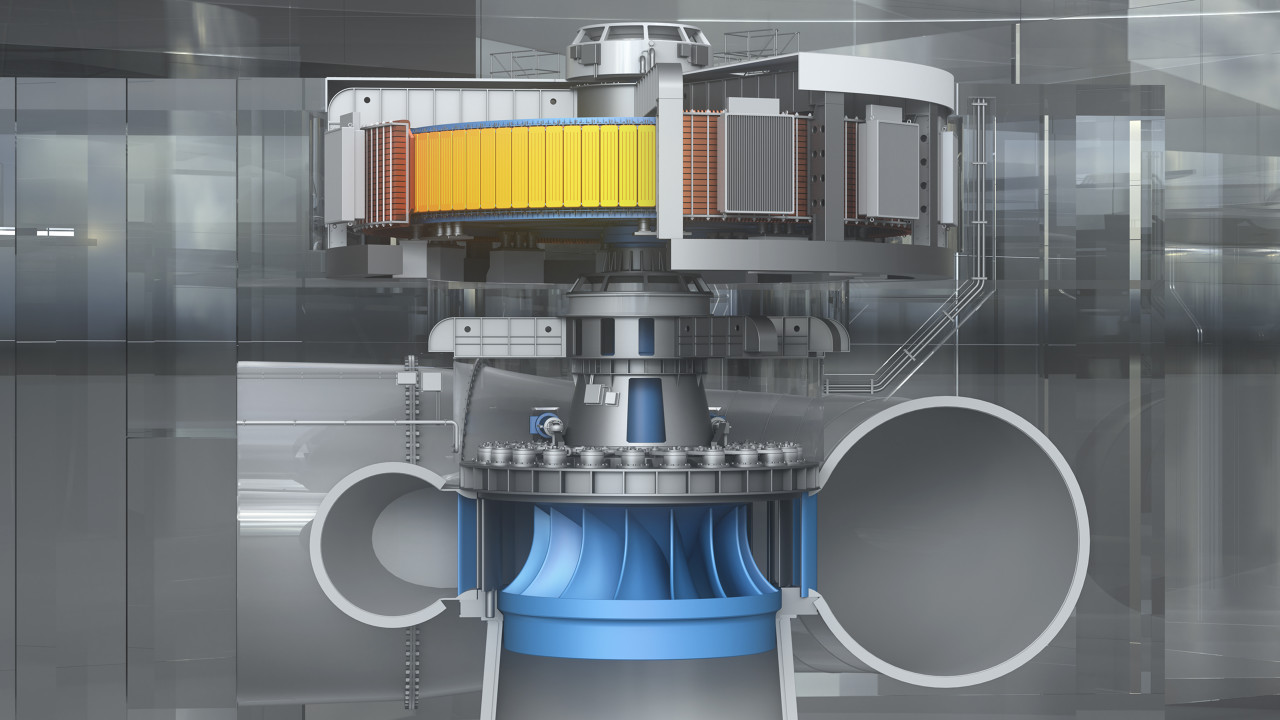
Uneven air gap between stator and rotor in large hydro-generators is by no means a trivial matter. It starts as an electromagnetic problem but quickly evolves into a comprehensive serious fault integrating electrical, mechanical, and thermal aspects. The unbalanced magnetic pull (UMP) it causes and the resulting severe vibration are the primary factors threatening the safe operation of the unit. Therefore, during unit installation, maintenance, and daily operation and maintenance, the uniformity of the air gap must be strictly controlled, and early signs of eccentricity faults must be detected and handled in a timely manner through online monitoring systems (such as vibration, current, and air gap monitoring).
Post time: Dec-18-2025